Why your test environments should be disposable
This article isn't available in your language yet — showing the original version.
A staging cluster that’s been running for six months isn’t really “staging” anymore. It accumulates leftover deployments, forgotten permissions, stale secrets, and unexplained configuration changes. Eventually nobody fully trusts it, and when something fails, the first question is: is the application broken, or is staging broken?
Stop cleaning up. Start disposing.
The usual fix is “better cleanup”—delete the namespace, wipe the database, remove the secrets, and hope the CI job’s cleanup step actually runs. Over time, the cleanup system becomes as complex as the thing it cleans.
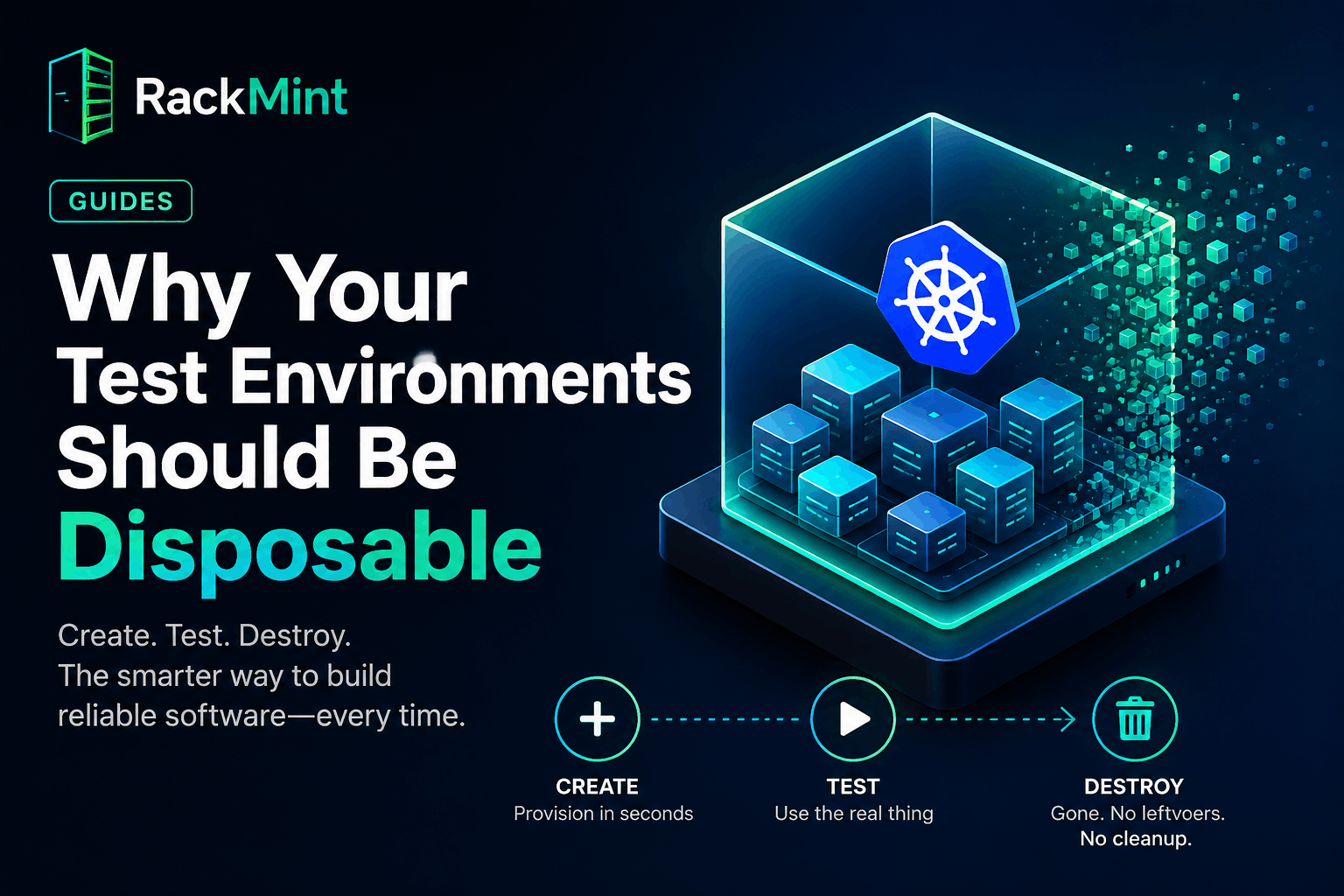
A simpler approach: don’t make the environment permanent in the first place. Create it, use it, destroy it. Each test run starts from zero, with no inherited state and no question about what changed yesterday. The environment becomes part of the test fixture itself.
Namespaces aren’t real isolation
Shared clusters rely on namespaces to separate workloads, but real applications don’t always cooperate—charts install cluster-scoped resources, secrets land in unexpected places, services reach across namespace boundaries. Platform teams end up building guardrails on top of guardrails, and noisy-neighbor problems persist regardless.
Giving each workload its own cluster sidesteps this entirely: if something goes wrong, the damage is contained in an environment that’s being deleted anyway.
Deploy the real thing instead of mocking it
Conventional integration tests mock dependencies—fake Redis, fake Postgres, fake APIs. That’s useful for unit tests, but it means you’re testing your app’s interaction with a simulation, not the real system. And simulations require their own maintenance as the real dependencies evolve.
Disposable environments let you skip mocking altogether. Deploy the actual backend, database, and cache. Real network, real ports, real auth, real failures.
Tests don’t need to share a language with the app
Since tests interact with a deployed system from the outside, they can live in a separate repository, written in whatever language suits the job—Playwright for browser testing, a simple HTTP client for API testing. The app doesn’t need to know how the tests work, and the tests don’t need to understand the app’s internals.
Useful beyond automated testing
The same model helps manual QA, developers reproducing bugs, support teams recreating customer issues, and AI coding agents. The shared need is always the same: a clean, real deployment to interact with—not a queue for a shared staging environment.
Why this matters more for AI agents
An agent iterating on code can loop through change → deploy → test many times. Mocks force the agent to reason about test-specific abstractions—which client is faked, how the mock is injected, which fixture to update. A real deployment instead gives direct, honest signals: an HTTP 500, a connection refused, a failed migration. The agent debugs the actual system, not a simulation of it.
The catch: creation has to be cheap
None of this works if spinning up an environment takes 30 minutes—people will just keep the old one alive, and you’re back to permanent staging. The real problem to solve isn’t “how do we delete old clusters,” it’s “how do we make creating a new one so fast that deleting the old one is the obvious choice.”
With RackMint, a Kubernetes cluster provisions in seconds, which changes the economics of the whole workflow. Rather than keeping one shared cluster and carving out temporary namespaces, the cluster itself becomes disposable—created, used, and destroyed per test run.
RackMint also doesn’t require you to bring your own Kubernetes cluster. You can bring the compute (a VPS, EC2 instance, bare metal) and RackMint manages the Kubernetes lifecycle on top of it—keeping workloads on infrastructure you control.
Reliability matters as much as speed
Saying an environment “will disappear” isn’t enough—the system has to actually guarantee it. Deletions can fail, nodes can go unavailable, operations can race. RackMint combines TTL-based expiry with continuous reconciliation that retries incomplete operations until the environment reaches its intended state.
Creation and deletion on the same compute node are serialized with a lock, so a new cluster is never built while an old one is still tearing down. The control plane talks to compute through addressable RPC rather than SSH, treating create/delete/status operations as first-class infrastructure calls rather than shell scripts—SSH stays an emergency fallback, not a dependency.
HTTPS is part of the lifecycle too: the goal isn’t “how fast can I create a cluster” but “how fast can I get a real app running at a real HTTPS endpoint.” With a wildcard certificate already in place, new subdomains provision quickly.
And deletion needs to mean deletion—no leftover compute, databases, ingress, secrets, volumes, or DNS records. The full lifecycle runs through provisioning, ready, running, expiring, cleanup, and deleted, with reconciliation catching anything that stalls along the way.
When to keep environments around
Some environments deserve to persist—demos, shared integration environments, long-running dev workspaces, customer previews, or anything expensive to rebuild. That’s fine, as long as it’s a deliberate choice rather than a default born from the pain of recreating environments.
The default for testing should be create, test, destroy—not create, keep forever, and repair.